
 Alan Carr
What Is a Bespoke Website?
A bespoke website is a website created specifically for the requirements of an individual business or organisation. Rather than beginning with a pre-designed template, its page layouts, navigation, content structure, visual identity and functionality are planned around the intended audience and purpose of the website.
The term bespoke means made to meet a particular set of requirements. In the context of websites, it describes an approach where the finished product is shaped by what the business needs, rather than the limitations of an existing design.
This does not mean that every element must be unusual or that every feature needs to be developed from scratch. A bespoke website can use established content management systems, existing software libraries and proven technologies while still providing an individually designed experience.
The important distinction is that the business requirements determine how the website is created, rather than an existing template determining what the business can achieve.
What You’ll Learn in This Guide
Understanding what a bespoke website involves can help you make better decisions when planning a new website or replacing an existing one. This guide covers the following:
- What a bespoke website is: The meaning of a bespoke website and what distinguishes it from a standard website build.
- The key characteristics: How individual layouts, structured content and tailored functionality work together.
- The business benefits: How a custom-built website can support usability, brand consistency, performance and long-term growth.
- How bespoke websites are created: The stages involved in planning, designing, developing and launching a website.
- Practical examples: How different types of businesses can benefit from a website tailored to their requirements.
- Costs and suitability: When investing in a bespoke website makes sense and when a simpler solution may be enough.
What Makes a Website Genuinely Bespoke?
Changing the colours, fonts and images of an existing website template does not necessarily make it bespoke. A genuinely tailored website involves decisions about how information is presented, how visitors navigate the site and how its functionality supports the organisation.
The main characteristics of a bespoke website include:
- Individual page layouts: Pages are designed around their content and purpose rather than a predetermined layout.
- Purpose-led navigation: Menus and page structures reflect how visitors search for information and move through the website.
- A consistent visual identity: Typography, colours, imagery and interface elements reflect the organisation’s brand.
- Structured content management: Editing controls are created around the information the business needs to manage.
- Tailored functionality: Features are selected or developed to support specific business requirements.
- Considered technical development: The website is built using technologies and components appropriate to its purpose.
A bespoke website should still feel intuitive and familiar to its visitors. Individuality does not need to come at the expense of usability, accessibility or established design conventions.
How Does a Bespoke Website Differ From a Standard Website?
A standard template website starts with a predefined layout and set of features. The business then adapts its content and branding to fit the available structure. A bespoke website begins with the business requirements before deciding how the website should look and function.
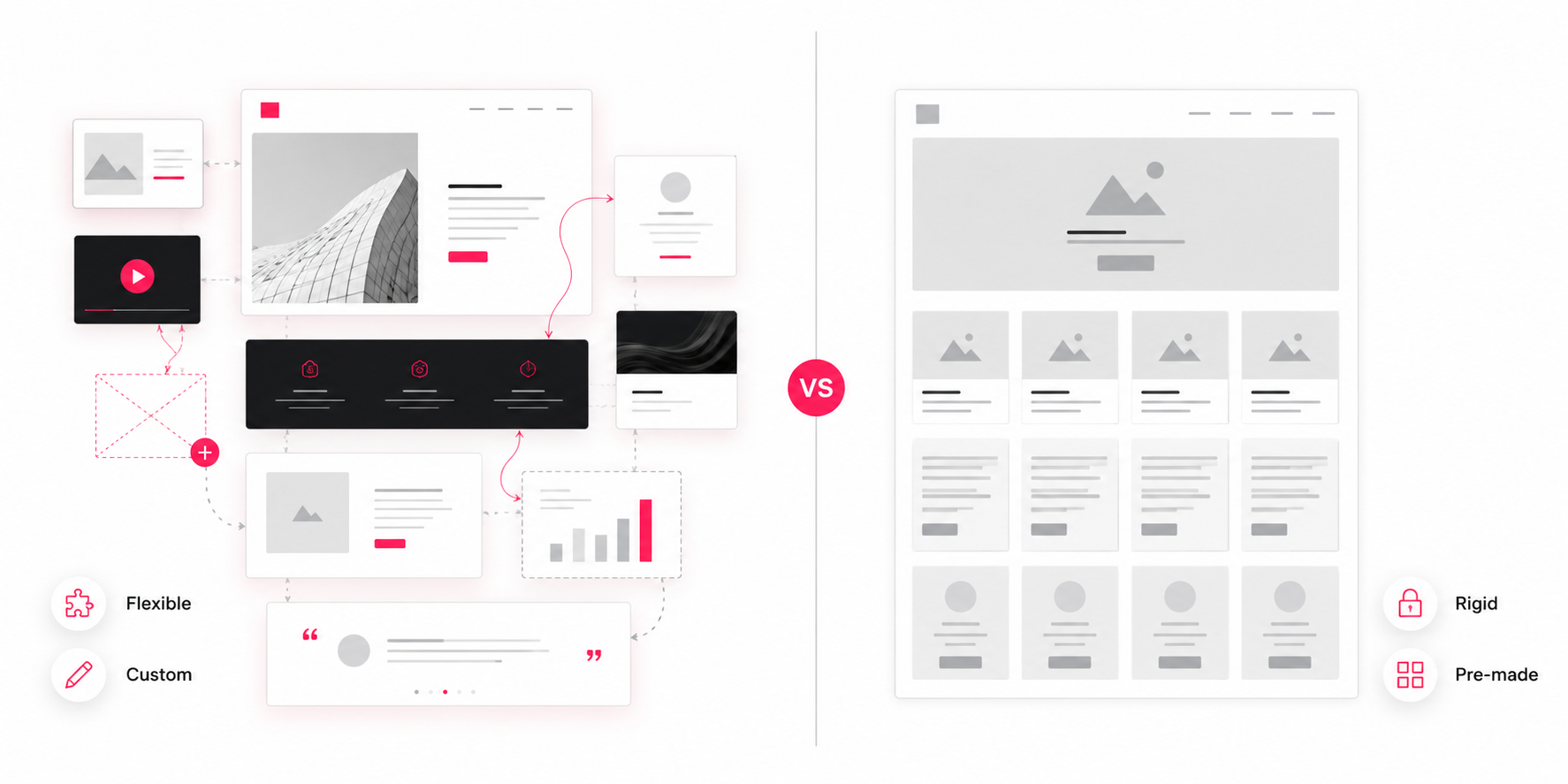
Custom-built websites offer more flexibility and control than rigid pre-made templates
Both approaches can produce a functional and professional website. Templates are often suitable for straightforward projects with limited requirements, while bespoke websites offer greater control when the organisation has more specific needs.
For a detailed comparison of pricing, development timescales, flexibility and long-term costs, read our guide to custom websites vs templates.
The Benefits of a Bespoke Website
The principal benefit of a bespoke website is the ability to make decisions about its design, content and functionality based on the needs of the business. This flexibility can provide several practical advantages throughout the lifetime of the website.
Stronger Brand Identity and Credibility
A bespoke website gives an organisation more control over how its brand is presented online. The visual experience can reflect the company’s positioning, values, audience and the quality of its products or services.
Rather than relying on familiar template layouts, businesses can establish a consistent identity through considered typography, photography, illustration, messaging and logo design.
This can be particularly valuable in competitive industries where prospective customers compare several businesses before deciding who to contact.
Clearer Navigation and User Journeys
Different audiences have different reasons for visiting a website. Some visitors want to compare services, others need technical information, and some are ready to make an enquiry or purchase.
A tailored website allows these journeys to be considered individually. Information can be organised in a logical order, relevant content can be connected, and important actions can be made easier to find.
The same principles apply to mobile devices, where navigation, content order, forms and interactive elements need to work effectively on smaller screens.
Better Opportunities for Conversion
A bespoke website can support the actions that matter most to an organisation, whether that means generating enquiries, encouraging bookings, collecting registrations or completing purchases.
For example, a business selling complex professional services might need detailed case studies, supporting information and a carefully structured enquiry process. An online retailer may need more effective product discovery, filtering and purchasing journeys.
Designing these experiences around customer needs can help reduce unnecessary friction. However, improved conversion rates still depend on factors such as the quality of the offer, messaging, traffic and ongoing optimisation.
Greater Control Over SEO Foundations
A bespoke website provides greater control over the structural and technical elements that support search engine optimisation. These can include page hierarchy, navigation, internal linking, heading structure, metadata, structured data and website performance.
Content areas can also be planned around the information visitors need, making it easier to introduce new articles, service pages and resources as the website develops.
Being bespoke does not automatically make a website rank higher in search engines. Search visibility depends on many factors, including content quality, relevance, competition and authority. The advantage is having a flexible technical foundation that supports ongoing SEO activity.
Improved Website Performance Potential
A website developed around specific requirements can avoid loading unnecessary features, scripts and design components that are sometimes included in general-purpose themes.
This gives developers greater control over how resources are loaded, how images are handled and how pages behave across different devices.
Actual performance still depends on development quality, hosting, third-party scripts, content and maintenance. Existing websites may also benefit from specialist WordPress performance optimisation without requiring a complete rebuild.
Easier Content Management
One of the less obvious benefits of a bespoke website is the opportunity to improve the experience of the people responsible for managing it.
Instead of presenting editors with unnecessary settings or complicated layout controls, the content management system can provide fields and reusable sections that reflect the information they regularly update.
A marketing team might need to publish case studies, create landing pages or update service information. A membership organisation might need to manage resources, events and member-only content.
Planning these requirements in advance can make everyday website management more straightforward and help maintain a consistent appearance as new content is added.
Functionality That Matches Business Requirements
A bespoke website can accommodate specific features and workflows that are difficult to achieve through standard website templates alone.
These might include integrations with existing business systems, specialised search tools, customer accounts, booking processes or custom reporting interfaces.
The aim is not to introduce unnecessary complexity. It is to ensure the website supports the way the organisation operates without forcing staff or customers into unsuitable processes.
Long-Term Flexibility and Scalability
Businesses rarely remain unchanged throughout the lifetime of a website. New services are introduced, teams expand, audiences change and marketing requirements become more sophisticated.
A well-planned bespoke website can accommodate these developments through reusable components, flexible content structures and an adaptable technical foundation.
This can make it easier to introduce new sections, functionality or integrations without replacing the entire website every time the organisation’s requirements change.
Better Long-Term Value and Control
Although a bespoke website generally requires a higher initial investment, it can provide better long-term value when the organisation relies heavily on its online presence.
Greater control over the codebase, content structures and functionality can reduce dependence on particular theme providers or restrictive software arrangements. Actual ownership and licensing rights should always be established within the project agreement.
The long-term value comes from having a website that can be maintained, improved and adapted as requirements evolve, rather than repeatedly investing in workarounds or unnecessary rebuilds.
Are There Any Disadvantages to Bespoke Websites?
A bespoke website is not automatically the right choice for every organisation. There are several considerations that should be evaluated before committing to a custom build.
- Higher initial investment: Individual planning, design, development and testing typically require more work upfront.
- Longer production times: Creating a website specifically for an organisation generally takes longer than configuring an existing template.
- More involvement during planning: Stakeholders may need to provide detailed feedback, content and functional requirements throughout the project.
- Ongoing technical maintenance: Custom code, integrations and content management systems still require appropriate updates and maintenance.
- Dependence on development quality: Poorly documented or unnecessarily complex custom development can make future changes difficult.
These considerations make it important to establish clear requirements, use appropriate technologies and ensure the website can be maintained after launch.
Can a Bespoke Website Be Built With WordPress?
Yes. A bespoke website can be built using WordPress or another established content management system. The term bespoke describes how the website is planned and developed, rather than which platform it uses.
A tailored WordPress website can use individual page templates, structured content fields and reusable components without relying on an off-the-shelf theme.
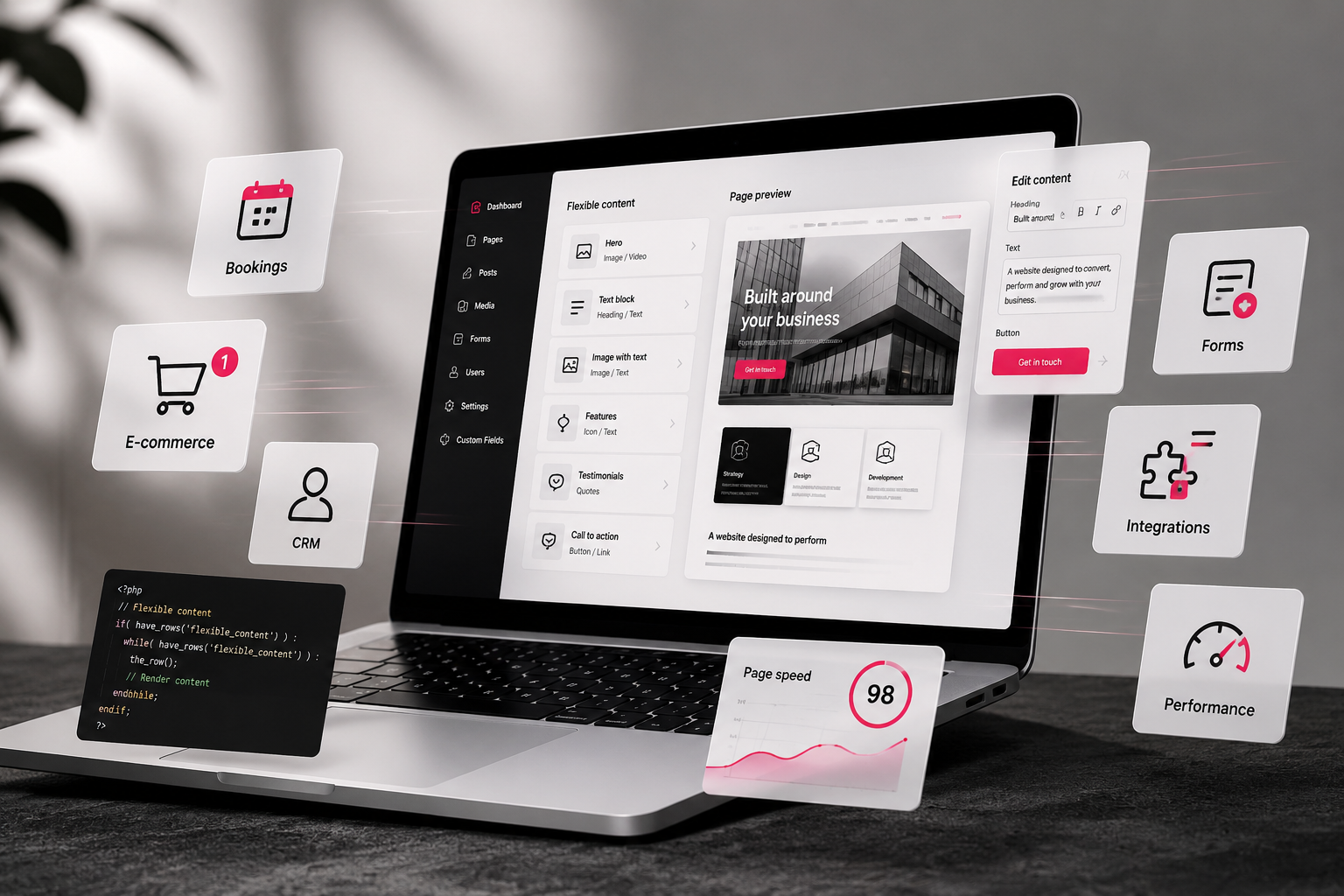
Flexible content helps custom websites stay easier to update and extend
For example, many of the websites we create at Webpop Design use a custom WordPress theme with Advanced Custom Fields (ACF).
This allows editors to create pages using predefined content sections, such as text and image layouts, testimonials, statistics, case studies and frequently asked questions.
Each component follows the website’s design system, helping the organisation maintain visual consistency while giving its team the freedom to update and reorganise content.
The trade-off is that these components need to be planned and developed upfront. This approach is particularly suitable for organisations that want flexible content management within an established visual identity.
Examples of Bespoke Website Functionality
The functionality included in a bespoke website depends on what the organisation needs to achieve. Some websites require little more than well-structured content, while others need to support more complex customer journeys or business processes.
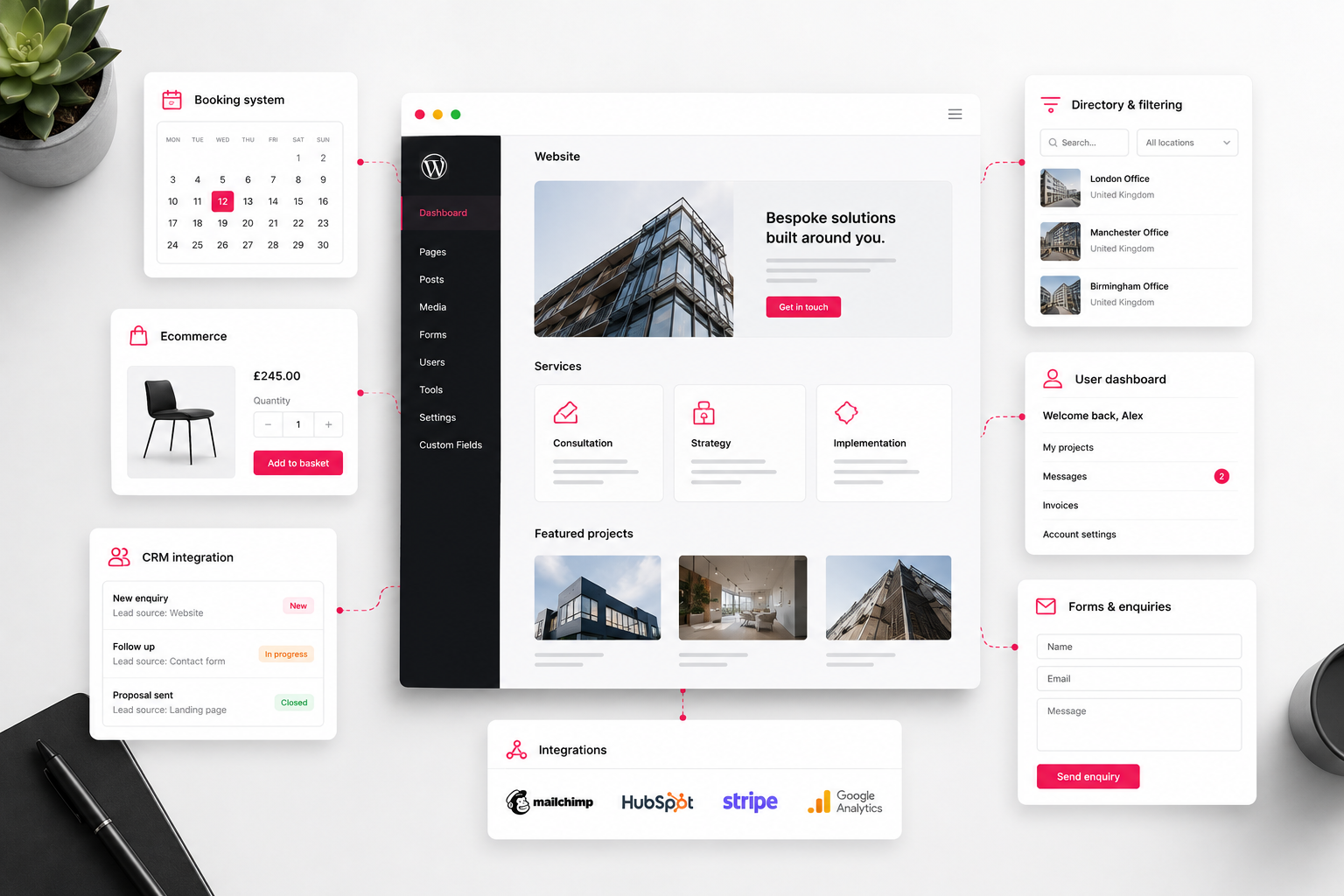
Custom functionality can be shaped around your business goals, users and workflows
- Booking systems: Appointment scheduling, consultation bookings, event registrations and availability management.
- Directories: Searchable listings, filtering systems, individual profiles and location-based content.
- Customer dashboards: Secure areas where customers can access documents, account information or specific tools.
- Online stores: Tailored bespoke ecommerce websites with specialised product information, filtering or purchasing journeys.
- Membership areas: Restricted content, user registration, subscriptions and account management.
- Third-party integrations: Connections with CRM systems, payment providers, email marketing platforms and internal business software.
- Interactive tools: Calculators, product configurators, assessments and other features that help visitors make informed decisions.
Not every feature needs to be individually programmed. Existing plugins, APIs and software services can form part of a bespoke website where they provide a reliable and appropriate solution.
Examples of How Businesses Use Bespoke Websites
To understand how bespoke websites work in practice, it helps to consider the different requirements organisations may have.
Professional Services Businesses
A consultancy or professional services firm may need to communicate detailed service offerings, demonstrate expertise and help prospective clients find information relevant to their industry. Individual page structures, case studies and enquiry journeys can support these requirements.
Manufacturers and Technical Businesses
A manufacturer may need to present complex product specifications, downloadable documentation, technical resources and searchable product ranges. Structured content management can make large amounts of information easier to maintain and navigate.
Online Retailers
An ecommerce business may need specialised product pages, advanced filtering, customer-specific pricing or connections with stock management systems. A tailored website can accommodate these requirements without relying solely on standard storefront functionality.
Membership Organisations
A membership organisation may need public information alongside restricted resources, member profiles, event registration and account management. Different user groups can be given access to the information and functionality relevant to them.
You can explore completed projects across different industries in our website portfolio.
How Is a Bespoke Website Created?
Creating a bespoke website typically involves several stages. Each stage helps establish what the website needs to achieve before decisions are made about its appearance and technical development.
- Discovery: Understanding the organisation, its audience, objectives, existing challenges and functional requirements.
- Information architecture: Planning the sitemap, content hierarchy, navigation and relationships between different pages.
- Wireframing: Establishing page layouts and user journeys before developing the final visual design.
- Visual design: Creating individual page designs, interface components and responsive layouts that reflect the organisation’s identity.
- Development: Translating approved designs into a functioning website with appropriate content management and technical features.
- Content integration: Adding and organising the information, imagery and resources required for launch.
- Testing and launch: Checking functionality, responsive behaviour, accessibility, performance and compatibility before making the website available to visitors.
- Ongoing improvement: Reviewing website performance and introducing improvements as the organisation’s requirements develop.
The complexity of each stage depends on the size of the project. A straightforward website may require fewer individual page layouts and integrations than a large platform with multiple audiences and specialised functionality.
How Much Does a Bespoke Website Cost?
The cost of a bespoke website depends on its scope, complexity and functional requirements. There is no universal price because each project involves a different combination of planning, design and development.
Factors that influence the overall investment include:
- The number of individually designed page templates.
- The complexity of the website’s structure and user journeys.
- The level of content preparation and migration required.
- The complexity of the content management system.
- Custom functionality and third-party integrations.
- Accessibility, testing and performance requirements.
- Ongoing hosting, maintenance and development.
When evaluating the cost, it is worth considering both the initial project investment and the expected lifetime of the website. A website that can accommodate future requirements may offer better value than a less expensive solution that needs replacing sooner.
When Is a Bespoke Website Worth the Investment?
A bespoke website is worth considering when an organisation has requirements that cannot easily be met through a standard website setup.
This might include businesses that:
- Rely on their website to generate enquiries, bookings or sales.
- Need to communicate complex products or services.
- Require a distinctive and consistent brand experience.
- Have multiple audiences with different information needs.
- Need specific functionality or connections with existing systems.
- Have outgrown the limitations of their existing website.
- Expect their content, functionality and business requirements to expand over time.
For a temporary landing page, a straightforward brochure website or an early-stage business with limited resources, a simpler solution may be more appropriate.
The decision should be based on what the website needs to achieve, the resources available and how important the website is to the organisation’s operations and future growth.
Final Thoughts
A bespoke website is defined by how closely its structure, design, functionality and content management reflect the requirements of the organisation using it.
Its benefits can extend well beyond appearance, providing greater control over usability, content, performance, functionality and future development. However, the quality of the planning and implementation ultimately determines how useful the finished website becomes.
If your business has outgrown its existing website or requires a more tailored online experience, explore our bespoke web design services to learn how we approach individually planned website projects.
Frequently Asked Questions
What does bespoke mean in a website?
Bespoke means that the website has been created to meet the specific requirements of an individual business or organisation. Its structure, design, content and functionality are planned around those requirements rather than an existing template.
What is the difference between a bespoke website and a custom website?
The terms bespoke website and custom website are generally used interchangeably. Both describe a website that has been individually planned and developed to meet particular requirements rather than simply adapting a pre-designed template.
What are the main benefits of a bespoke website?
The main benefits include greater design flexibility, clearer user journeys, more control over technical performance, tailored functionality, easier content management and the ability to accommodate future business requirements.
Can a bespoke website be built using WordPress?
Yes. WordPress can be used as the content management system for a bespoke website. Individual themes, page templates, content fields and functionality can be developed around the specific requirements of the project.
How much does a bespoke website cost?
The cost depends on the size of the website, the number of individual page designs, the complexity of its functionality and the level of planning and development required. Bespoke websites generally require a higher initial investment than standard template websites.
How long does it take to create a bespoke website?
A straightforward bespoke website may take several weeks to complete, while larger projects with complex functionality, extensive content or third-party integrations can take several months. Timescales depend on the agreed scope, feedback and content availability.
Can I update a bespoke website myself?
Yes. A bespoke website can include a content management system that allows authorised users to update text, images, pages and other content without needing development knowledge. The editing experience can be tailored to the organisation’s requirements.
Does a bespoke website need ongoing maintenance?
Yes. Like other websites, bespoke websites require appropriate software updates, security checks, backups and technical maintenance. The level of maintenance depends on the technologies, functionality and integrations used.
Is a bespoke website right for every business?
No. A bespoke website is most useful when a business has specific design, content or functional requirements, or when its website plays an important commercial role. A simpler website may be more suitable for organisations with limited requirements or budgets.