
 Webpop Design Marketing Team
Ecommerce is not a single way of selling online. The right business model affects who your customers are, how you take payments, how your website is structured, how orders are fulfilled and what features your ecommerce website needs to support.
The six main types of ecommerce business models are B2B, B2C, C2C, C2B, B2A and C2A. Each one describes the relationship between the buyer and the seller. Once you understand that relationship, choosing the right platform, sales process and website functionality becomes much clearer.
Some articles focus on the four main types of ecommerce: B2B, B2C, C2C and C2B. However, the wider six-model view also includes transactions involving public administration, which is important for sectors such as government services, education, healthcare, procurement and local authority websites.
UK online retail remains an important part of the wider economy, with retail and ecommerce trends tracked by the Office for National Statistics. See the latest ONS retail and ecommerce data.
Quick Guide: The 6 Types of Ecommerce
The types of ecommerce can be divided into six main business models. Each model defines how products or services are exchanged online, who the buyers and sellers are, and what kind of website is usually required.
- B2B (Business-To-Business): Transactions between companies, involving bulk orders or accounts.
- B2C (Business-To-Consumer): Businesses selling products or services to shoppers online.
- C2C (Consumer-To-Consumer): Consumers selling products or items through marketplaces.
- C2B (Consumer-To-Business): Individuals offering services or content to companies.
- B2A (Business-To-Administration): Businesses providing goods or services to public bodies.
- C2A (Consumer-To-Administration): Consumers accessing or paying for public services.
Quick Comparison of The 6 Ecommerce Business Models
The table below gives a quick overview of how each ecommerce model works, who it is best suited to, and what it usually means from a website planning point of view.
| Model | Relationship | Common Examples | Website Requirements |
|---|---|---|---|
| B2B | Business to business | Wholesalers, manufacturers, SaaS providers, trade suppliers | Trade accounts, custom pricing, quote requests, bulk ordering and system integrations |
| B2C | Business to consumer | Online shops, fashion brands, grocery retailers, subscription brands | Product pages, fast checkout, mobile optimisation, reviews and clear delivery information |
| C2C | Consumer to consumer | Marketplaces, resale platforms, second-hand goods websites | User accounts, listings, messaging, ratings, payment protection and moderation |
| C2B | Consumer to business | Freelancer platforms, influencer campaigns, creator marketplaces | Profiles, project briefs, applications, messaging, secure payments and review systems |
| B2A | Business to administration | Suppliers selling to councils, government bodies, NHS trusts or public organisations | Procurement content, compliance information, case studies, accessibility and secure document handling |
| C2A | Consumer to administration | Tax portals, NHS bookings, licence renewals, benefits applications | Accessible forms, secure accounts, clear instructions, confirmation messages and support routes |
Business-To-Business (B2B)
B2B ecommerce covers online transactions between companies. This could include wholesalers supplying retailers, manufacturers selling to distributors, or software providers selling subscriptions to corporate clients.
Common B2B examples include Booker Wholesale supplying convenience stores, Alibaba Business connecting UK buyers with overseas manufacturers, and SaaS platforms selling software to organisations on a monthly or annual contract.
B2B orders often involve larger quantities, negotiated pricing, repeat purchasing and more complex approval processes. A B2B ecommerce website may need customer accounts, quote requests, bulk ordering, custom price lists, invoice payments, purchase order support and integration with stock, CRM or procurement systems.
In our experience, this is where off-the-shelf themes and page builders tend to creak. Once trade accounts, account-specific pricing and quote requests have to talk to a stock or CRM system, a bespoke WooCommerce build with custom fields is usually the more reliable route. SME Market is one of the B2B stores we have built where that trade relationship shapes how the whole site works.
The main advantages of B2B ecommerce include higher order values, repeat revenue and long-term customer relationships. The challenges are usually longer sales cycles, more complex requirements and a smaller pool of potential customers.
For B2B buyers, trust matters as much as price. They need confidence that the supplier can deliver accurately and at the volumes they order. That means the ecommerce website needs to make product data, availability, ordering and support as clear as possible.
For a plain primer across ecommerce models, see Investopedia’s ecommerce guide.
Business-To-Consumer (B2C)
B2C is the most familiar form of ecommerce. In this model, businesses sell products or services directly to individual shoppers through an online storefront.
Well-known UK examples include ASOS, Tesco and John Lewis. Their websites focus on making the buying process fast, simple and secure, with clear navigation, detailed product information, delivery options, reviews, returns information and a straightforward checkout.
B2C covers a wide range of sectors, from fashion, electronics and groceries to digital products, memberships and subscription-based services. The customer is usually making a personal buying decision, so the website needs to build confidence quickly.
Success in B2C ecommerce depends on strong product pages, clear pricing, fast loading times, mobile optimisation, secure payment options and reliable delivery. Good photography, useful descriptions, social proof and clear returns policies are often what lifts conversion rates the most. UK Home Interiors is one of the B2C stores we have built, where product presentation and a simple checkout carry most of that weight.
Many B2C sellers choose platforms such as Shopify or WooCommerce because they scale well and connect easily to marketing, inventory and customer support tools.
Our own view, as a WooCommerce agency, is that Shopify makes sense for a straightforward catalogue you want live quickly, while WooCommerce earns its place when you need custom pricing logic, content built around the products or full control of your own data.
B2C ecommerce gives you a large customer base, fast product launches and the freedom to test offers quickly. The trade-off is heavy competition, rising advertising costs, price pressure and the work of keeping the customer experience consistent.
Consumer-To-Consumer (C2C)
C2C ecommerce involves individuals selling directly to other individuals, usually through a third-party marketplace. The platform provides the listing tools, search functionality, messaging, payment processing and trust mechanisms that make the transaction possible.
Common UK examples include Gumtree, Facebook Marketplace and Vinted. These platforms make it easy for people to list second-hand goods, collectibles, clothing, furniture or handmade items without needing to build their own ecommerce website.
C2C ecommerce relies heavily on trust. Buyers and sellers usually do not know each other, so platforms need verified accounts, ratings, reviews, secure payments, moderation tools and dispute processes. Without those safeguards, scams, counterfeit goods and misrepresented items can quickly damage the user experience.
C2C ecommerce has low barriers to entry, puts sellers in front of large marketplace audiences and gives consumers a simple route to sell items they no longer need. Buyers can often find lower prices, rare products or items that are no longer available through mainstream retail.
The challenges include inconsistent product quality, unreliable communication, fraud risk and limited control over the final transaction. For businesses planning a marketplace-style ecommerce website, those risks need to be considered early because trust, moderation and user management are central to the model.
Consumer-To-Business (C2B)
C2B ecommerce reverses the traditional selling process. Instead of a business selling to a customer, an individual provides value to a business.
This model is common across freelancing, influencer marketing, content creation, affiliate partnerships, stock photography, software testing and user-generated product feedback. UK freelancers may use platforms such as PeoplePerHour to offer design, writing, marketing or technical services to companies.
In C2B ecommerce, the individual may set a fixed rate, negotiate a fee, work on commission or earn based on performance. For businesses, the model provides access to flexible talent, specialist skills and niche audiences without the commitment of hiring a permanent employee.
The advantages for individuals include flexibility, earning potential and control over the type of work they accept. For businesses, the draw is speed, specialist expertise and the chance to test campaigns or services without building a large internal team.
The main challenge is consistency. Quality, availability, communication and deadlines can vary between providers. This is why many C2B platforms rely on vetting, ratings, messaging, escrow payments and clear project scopes to keep the transaction fair for both sides.
Business-To-Administration (B2A)
B2A ecommerce covers sales from businesses to public sector bodies. This can include supplying technology, office equipment, consultancy, catering, construction services, training, professional services or digital systems to government departments and public organisations.
In the UK, public sector opportunities are often advertised through formal procurement channels. The government’s Contracts Finder platform lists public sector contracts and supplier opportunities. Browse Contracts Finder.
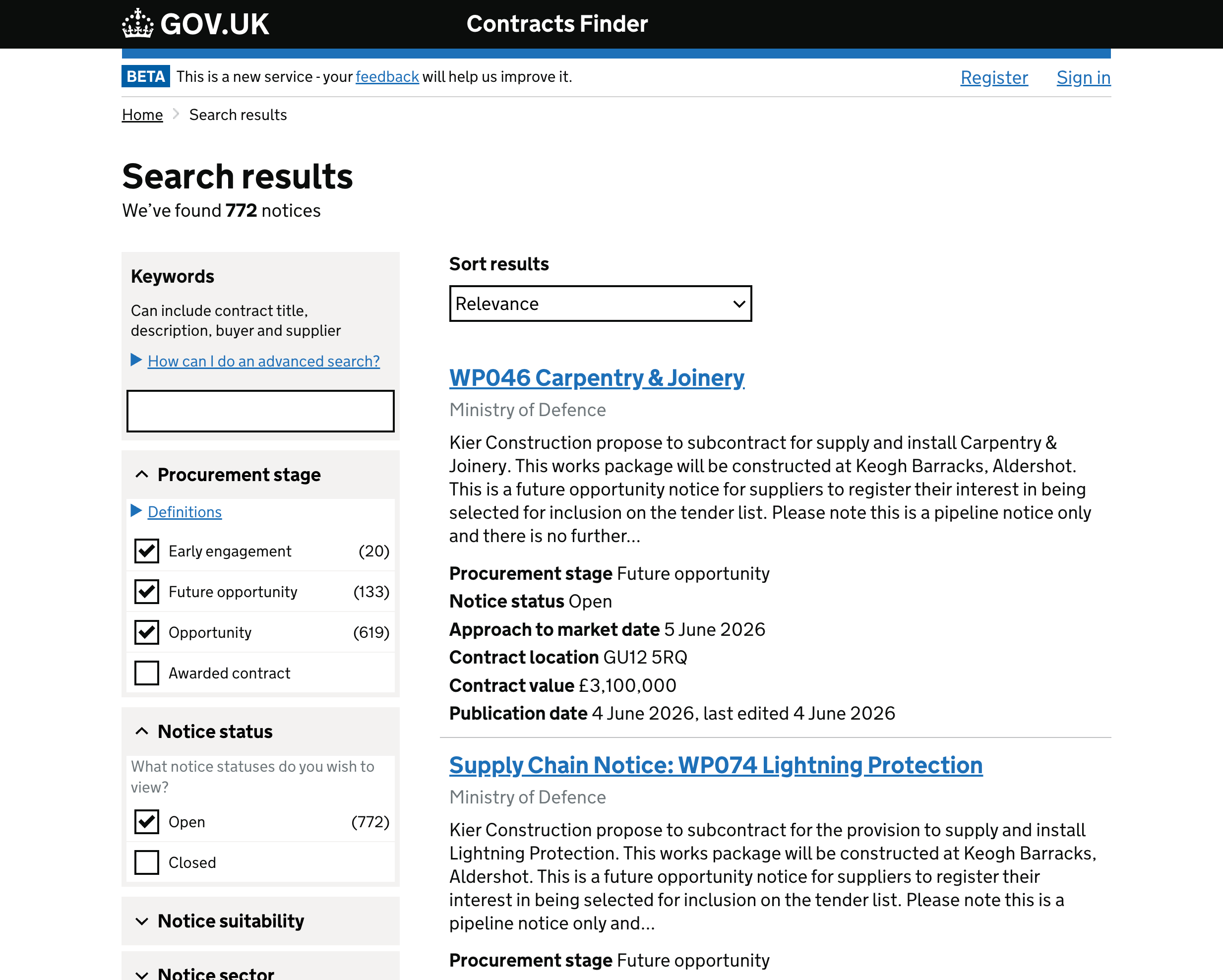
Contracts Finder is an example of B2A ecommerce, where businesses search for public sector opportunities online.
B2A ecommerce often involves more formal processes than standard B2B selling. Suppliers may need to complete tenders, provide compliance documents, meet security standards, prove financial stability and show evidence of relevant experience.
B2A ecommerce offers steady demand, long-term agreements and the credibility that comes from working with public sector clients. A successful contract can also become a strong reference when bidding for future work.
The challenges are slower sales cycles, strict documentation, procurement rules and high expectations around security, accessibility, delivery and accountability. Businesses targeting B2A need a website that communicates credibility clearly, especially around capability, compliance, case studies, accreditations and procurement-friendly information.
Consumer-To-Administration (C2A)
C2A ecommerce describes online interactions between individuals and public services. These are not always commercial transactions in the usual sense, but they still involve digital systems that allow citizens to submit information, make payments, book services or access records online.
Examples include submitting self-assessment tax returns through HMRC, booking NHS appointments, renewing licences, applying for benefits or accessing local authority services from home.
C2A systems can improve convenience, reduce paperwork and make essential services available outside normal office hours. They can also help public bodies automate routine tasks and free staff to deal with more complex cases.
The risks are significant because these platforms often handle sensitive personal, financial or health-related information. Security, privacy, accessibility and reliability are essential. A poor user experience can exclude people with limited digital skills, disabilities or unreliable internet access.
For public sector and civic websites, C2A is a reminder that ecommerce-style functionality is not only about selling products. Payment systems, forms, account areas, booking tools and document submission features all need to be planned around trust, accessibility and ease of use.
Ecommerce Business Models vs Revenue & Fulfilment Models
One common source of confusion is the difference between an ecommerce business model, a revenue model and a fulfilment model.
An ecommerce business model describes who is selling to whom. For example, B2B means a business sells to another business, while B2C means a business sells to individual consumers.
A revenue model describes how the business makes money. This could include direct product sales, subscriptions, commission, memberships, licensing, advertising, paid downloads or recurring service fees.
A fulfilment model describes how the product or service is delivered. This could include holding stock, dropshipping, print-on-demand, white labelling, private labelling, wholesale supply, digital delivery or third-party logistics.
These categories often overlap. A B2C brand might sell its own private label products through Shopify. A B2B supplier might use WooCommerce with trade accounts and wholesale pricing. A C2C marketplace might earn commission on each transaction. Understanding the difference helps you plan the website properly instead of choosing features based on vague assumptions.
Common Ecommerce Revenue & Fulfilment Models
Although B2B, B2C, C2C, C2B, B2A and C2A describe the main ecommerce relationships, many businesses also use specific revenue or fulfilment models. These affect how the website is built and how the customer journey works.
- Dropshipping: The retailer sells products online while a third-party supplier handles stock and fulfilment.
- Subscription Ecommerce: Customers pay on a recurring basis for products, services, memberships or access.
- Wholesale Ecommerce: Products are sold in bulk, usually to retailers, trade buyers or other businesses.
- Private Label: A business sells products manufactured by another company under its own brand.
- White Label: A generic product or service is rebranded and sold by another company.
- Print-On-Demand: Products are created only after an order is placed, reducing the need to hold stock.
- Marketplace Commission: The platform earns money by taking a fee from transactions between buyers and sellers.
These models are not separate from the six ecommerce types. They sit underneath them. For example, a B2C ecommerce brand could use subscriptions, dropshipping or private label products. A B2B business could use wholesale pricing, quote requests and account-based ordering.
Advantages Of Ecommerce
Ecommerce allows businesses to reach customers beyond their immediate location. A company can sell locally, nationally or internationally without relying on a physical shopfront.
It also gives customers more control over how they buy. They can compare products, read reviews, check delivery options and complete a purchase at any time of day. For businesses, this creates more opportunities to capture demand through search engines, social media, email marketing and paid advertising.
Ecommerce can also reduce manual work. Orders, payments, invoices, stock updates, delivery notifications and customer emails can often be automated. This saves time and gives businesses better data on customer behaviour, product performance and marketing activity.
The commercial benefit is not only that ecommerce can generate sales online. A well-planned ecommerce website can improve margins, increase repeat purchases, support customer retention and make the business easier to scale.
Disadvantages Of Ecommerce
Ecommerce also creates risks. If the website goes down, sales can stop immediately. If payment systems fail, customers may lose trust. If product information is weak, returns and support requests can increase.
Security is another major concern. Online fraud, phishing, data breaches and poor password practices can damage both the customer and the business. Ecommerce websites need secure hosting, reliable payment processing, software maintenance and sensible data handling.
Logistics can also be difficult. Delivery delays, lost parcels, stock errors and high shipping costs can quickly affect customer satisfaction. For B2C sellers in particular, clear delivery information and returns policies are essential.
Some customers still prefer the reassurance of buying in person. Ecommerce websites need to work harder to build confidence through product photography, detailed descriptions, reviews, clear contact information, visible policies and professional design.
Choosing The Right Ecommerce Model For Your Business
The best ecommerce model depends on your market, product, budget, sales process and delivery method. It also depends on how much control you need over pricing, customer relationships, fulfilment and technology.
A B2C business usually needs a fast storefront, persuasive product pages, simple checkout and strong marketing integrations. A B2B business may need trade accounts, custom pricing, repeat ordering, quote requests and integration with internal systems.
A marketplace-style C2C platform needs a completely different structure, with user profiles, listings, seller dashboards, payment handling, reviews, moderation and dispute processes. A C2B platform may need project listings, application flows, portfolio profiles, messaging and secure payment features.
B2A and C2A projects often need extra attention around accessibility, documentation, security, compliance and public trust. In these models, clarity and reliability are just as important as design.
Some businesses use more than one model. A retailer may sell direct to consumers through B2C, offer wholesale ordering through B2B and supply public sector organisations through B2A. In that case, the website needs to support different customer journeys without becoming confusing. Black Sheep Press is a good example, selling to both consumers and trade buyers, so the site has to handle both journeys without either feeling like an afterthought.
What Your Ecommerce Model Means For Your Website
Your ecommerce model should shape the website from the start. It affects the structure, content, checkout, account features, integrations and conversion strategy.
- B2B websites often need account approval, trade pricing, quote requests, bulk ordering, invoice payments and integration with CRM, ERP or stock systems.
- B2C websites need strong product pages, fast checkout, mobile optimisation, reviews, abandoned basket emails and clear delivery and returns information.
- C2C marketplaces need seller accounts, listing tools, messaging, ratings, payment protection, moderation and dispute handling.
- C2B platforms may need freelancer profiles, campaign briefs, application flows, portfolio uploads, messaging and secure payments.
- B2A websites need clear capability statements, procurement-friendly content, compliance information, case studies, accessibility and secure document handling.
- C2A websites need simple forms, accessible interfaces, secure accounts, clear instructions, confirmation messages and reliable support routes.
This is why ecommerce planning should come before design. If the model is not clear, the website can end up with the wrong checkout, the wrong account structure or the wrong content hierarchy.
At Webpop Design, we plan ecommerce websites around the business model, sales process and operational requirements first. In practice, that means mapping the buying journey before the visual design stage, then planning the right features around accounts, payments, product data, subscriptions, fulfilment and integrations. That is the opposite of starting with a theme and bending the business to fit it, which is where a lot of ecommerce projects quietly go wrong.
That experience is especially useful for businesses that need more than a simple product catalogue. A WooCommerce build with trade pricing, a subscription website, a Shopify store with marketing integrations and a marketplace-style platform all need different decisions before development begins.
Why Knowing All Six Ecommerce Models Matters
Understanding the main types of ecommerce helps you choose the right structure for your business instead of copying a website that was built for a different model.
A simple B2C shop, a B2B trade portal, a subscription business and a marketplace may all involve online payments, but they need very different website features. The user journey, content, checkout flow, account area, pricing logic and integrations can all change depending on the model.
Knowing the difference also helps you spot opportunities. A business that starts as B2C may later add wholesale ordering. A service provider may introduce subscriptions. A platform may shift towards marketplace revenue. Planning for those possibilities early can save time and development cost later.
From small retailers investing in ecommerce web design to larger organisations managing multi-channel operations, the right model can influence revenue, customer loyalty and long-term growth.
Planning An Ecommerce Website Around The Right Model
Choosing the right ecommerce model is not only a business decision. It is also a website planning decision.
The model affects what your customers need to see, how they buy, how accounts work, how payments are handled and what systems the website needs to connect with. Getting this right early can prevent expensive rebuilds later.
Webpop Design creates bespoke ecommerce websites for businesses that need more than a basic online shop. Whether you are planning a B2C store, B2B trade portal, subscription website or more complex ecommerce platform, we can help you structure the website around the way your business actually sells.
View our ecommerce web design service page or submit our Project Planner to discuss your project.
Frequently Asked Questions About Ecommerce Business Models
What are the 6 types of ecommerce business models?
The six main types of ecommerce business models are B2B, B2C, C2C, C2B, B2A and C2A. These stand for business-to-business, business-to-consumer, consumer-to-consumer, consumer-to-business, business-to-administration and consumer-to-administration.
What are the four main types of ecommerce?
The four main types of ecommerce are usually listed as B2B, B2C, C2C and C2B. These cover most commercial ecommerce transactions. The wider six-model version also includes B2A and C2A, which involve public administration and government-related online services.
What is the most common ecommerce business model?
B2C is the most familiar ecommerce model because it includes online shops that sell directly to individual customers. However, B2B ecommerce is also highly significant because many companies now order products, software and services online.
How is an ecommerce business model different to a revenue model?
An ecommerce business model explains who is selling to whom. A revenue model explains how the business makes money. For example, a B2C business could make money through one-off product sales, subscriptions, memberships or digital downloads.
Which ecommerce model is best?
There is no single best ecommerce model. The right choice depends on your audience, product, pricing, fulfilment, sales process and long-term goals. A B2B supplier, consumer brand, marketplace and subscription business all need different strategies.