
 Alan Carr
Choosing the right agency starts with comparing scope, process, quality and long-term value.
Your website is often where a potential client decides whether to enquire or move on. Choosing the right web design agency is therefore a commercial decision as much as a creative one. The right agency should help you plan the structure, user journey, design, content, development and launch of your website so it supports your wider business goals.
At Webpop Design, this is how we approach website projects ourselves. After more than 18 years designing and developing websites, we’ve seen how much difference a clear brief, proper technical planning and honest scope makes before design even starts. Our work spans bespoke WordPress websites, WooCommerce builds, custom functionality, accessibility improvements and long-term support, so the advice below is based on real project delivery rather than theory.
This guide explains what to look for when choosing a bespoke web design agency, what questions to ask, what red flags to avoid and how to compare agencies before signing a proposal.
Quick Tips for Choosing the Right Web Design Agency
Before you commit to an agency, keep these essentials in mind:
- Know your website goals – Define your purpose, audience, users, must-have features and commercial objectives before speaking to agencies.
- Look beyond the portfolio – Review live websites, not just static screenshots. Check speed, mobile layouts, navigation, content structure and calls to action.
- Understand their strengths and tech stack – Make sure the agency has the right design, development, CMS, SEO and support experience for your project.
- Ask about process, ownership and support – A good agency should explain how the project runs, what you own, what happens after launch and how future changes are handled.
- Compare value, not just price – The cheapest quote is not always the safest choice. Look at scope, quality, communication, technical depth and long-term flexibility.
- Watch for red flags – Be cautious if an agency avoids clear answers, skips discovery, hides ownership terms, promises unrealistic timelines or cannot explain their process.
Consider Your Website Requirements
Before choosing an agency, be clear on your requirements and goals for your website. For example, do you want your website to focus on increasing conversions or would you prefer it to be more informational? Do you know how many pages you require? Who is your target audience? Do you need ecommerce web development? By establishing your requirements and being clear on what you want your website to achieve, your initial enquiries with web design agencies will be much more useful.
You do not need every detail finalised before you speak to an agency. A good agency should help you clarify what matters most. However, you should have a basic idea of your goals, budget, timescale, audience, content needs and any important functionality before asking for a proposal.
If you already have a website and are seeking a redesign, be clear about what is currently working well and what is not. Is the site failing to generate enquiries? Is it difficult to update? Is the design dated? Are users struggling to find important information? By identifying the problem you are trying to solve, you give the agency a much clearer brief and make it easier to measure success.
2
Explore the Range of Services Available
A reputable web design agency will usually offer a wider range of services than visual design alone. This matters because a successful website relies on more than how it looks. It also needs to be planned, written, structured, developed, tested, launched and supported properly.
The services a website design company typically offers include:
A good agency will be experienced in managing the whole process from website design through to development and launch. They should also ensure that your website is responsive, accessible, easy to manage and built with performance in mind. They should make your website accessible as well as functional, well designed and easy to navigate.
This does not always mean you need a large full-service agency. Smaller specialist agencies can often be a better fit if you need hands-on input, direct communication and a more bespoke approach. What matters is knowing what is included, what is not and where the agency’s real strengths sit.
3
Understand Their Expertise and Specialisms
Every web design agency works slightly differently and will specialise in different areas of the web design and development process. By reviewing their portfolio, process and services, you should be able to establish their strengths quickly.
If you’re looking for a bespoke web design with custom transitions or advanced functionality, you’ll likely want to find an agency that specialises in bespoke website design and development. (Learn what custom web design is here). This helps confirm the agency can design a distinctive website and develop it with the level of functionality, flexibility and control you require.
If you’re simply looking for a small static website with a generic design, then a bespoke service may be less important. In that case, a simpler template-based approach could be more cost-effective. The right choice depends on your goals, budget, brand requirements, content needs and how much control you need over the website in future.
Another consideration is what CMS the agency will use to build your website. A CMS, or Content Management System, enables you to manage and update your website’s content over time. There are several CMS options to choose from, with WordPress currently one of the most widely used. Each CMS carries different implications for flexibility, ownership, ongoing costs, plugin reliance, editing experience and scalability.
For example, Webpop Design usually works with bespoke WordPress builds where the design, content structure and editing experience are planned around the client rather than forced into a generic theme. This is especially useful when a business needs flexible page layouts, custom functionality, WooCommerce logic or a website that can grow without being rebuilt every few years.
You should also ask whether the agency builds custom themes, adapts existing themes, uses page builders or relies heavily on third-party templates. These approaches are not all equal. Page builders can look like the quick option, but they often produce slow, bloated pages and tie a client to a tool they cannot easily leave. Bespoke templates built on flexible content fields give editors the freedom to add and reorder sections without that performance cost or lock-in.
In our experience, a build’s long-term health is shaped most by how many plugins it leans on. We work to the smallest plugin that solves the problem rather than stacking a dozen, because every plugin you add has to be updated, secured and kept compatible for years. It is worth asking any agency how many plugins a typical build of theirs uses, and why each one is there.
4
Look Beyond the Portfolio Screenshots
Review a web designer’s portfolio before making a decision. It shows the quality of their work and how well they adapt their style to different industries. It also shows whether they have experience in your sector or with similar types of website.
However, portfolio screenshots only tell part of the story. A website can look impressive in an image but perform poorly in real use. Where possible, click through to live websites and assess how they feel on desktop and mobile. Look at page speed, navigation, readability, calls to action, content structure, spacing, accessibility, forms and how easy it is to complete key actions.
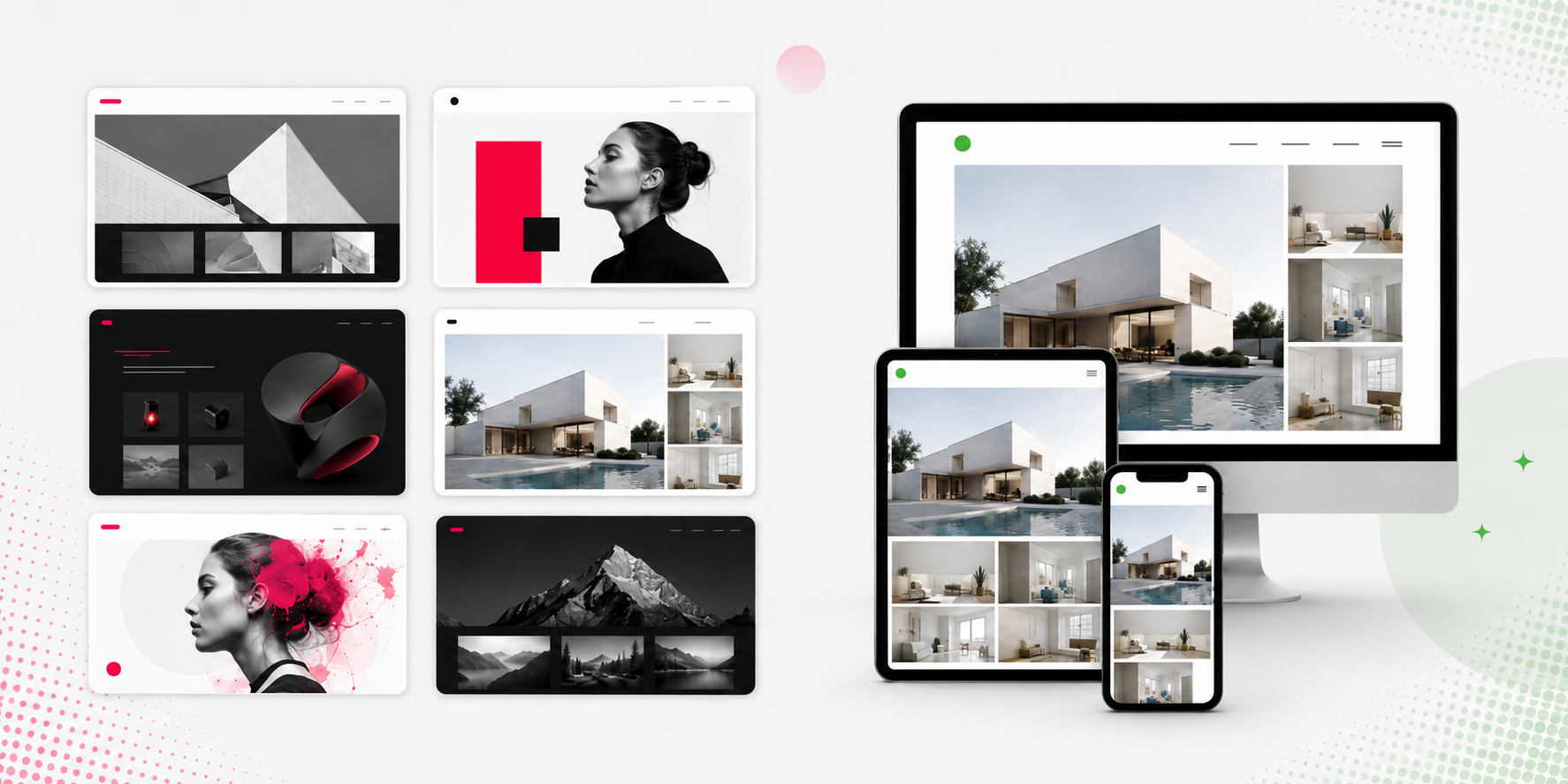
A portfolio shows design style, but live websites show usability, speed and responsive performance.
Next, look at the attention to detail within the designs. Does the layout work well? Is it intuitive to use? A good website should do more than look good. It should be easy to navigate, clear in its messaging and structured around the needs of real users. A consistent design also reinforces your brand, so look at typography, layout, spacing and visual hierarchy across each project.
Design is subjective, so you are unlikely to love every example you see. A good website design agency will adapt its work to suit each client’s audience, brand and goals. Assess the agency’s skill, judgement and consistency rather than judging every example by your personal taste.
When reviewing our own web design portfolio, we recommend looking at the live websites as well as the visuals. The strongest projects are not the ones that just look good in a screenshot. They are the ones that are easy to use, fast to navigate and structured around real business goals.
5
Check Reviews and Reputation
Another important factor when choosing a web design agency is their reputation. Start by looking at their reviews and client feedback. Reviews show you what past clients experienced and what the agency does particularly well. They can also show how the agency communicates, manages expectations and responds when problems arise.
Reputable web design agencies will usually display client reviews, testimonials or case studies on their website. This helps you gauge client satisfaction and professionalism. A complete lack of visible feedback is not always a deal-breaker, but it is worth questioning if an agency is asking you to make a significant investment.
Some agencies gather reviews on third-party sites such as Clutch or Google reviews, which provide a star rating along with comments from the client. Although no agency is perfect, look for patterns. What does the agency consistently do well? If there are negative comments, are they one-off issues or repeated problems? If you are looking for a specific service, such as ecommerce web design, it can also help to look for reviews linked to similar projects.
You can also check whether the agency is active on platforms such as LinkedIn. A regularly updated profile is not proof of technical skill, but it shows the agency is still active and engaged in its work. More importantly, look for evidence that the agency understands its clients’ businesses, not just its own marketing.
6
Book an Initial Consultation
Before you decide which web design agency to partner with, book an initial consultation to discuss your project and ask about their approach to website design.
During the consultation, you should expect to provide details about your business, your target audience and your website goals. The agency will ask questions relating to your website design brief, which could include how many pages you require, the functionality you need and any specific features your website must include. A good agency will also challenge unclear ideas, suggest better alternatives where appropriate and help you prioritise what matters most.
A website project is collaborative, so it helps to understand how the agency works. That way you feel supported throughout the project and know what is expected from both sides. During the consultation, you should be able to assess the agency’s communication style, level of customer service and ability to explain technical decisions clearly.
Pay attention to the questions the agency asks you. If they only ask about colours and design references, they may not be thinking deeply enough about your goals. Strong agencies will usually ask about your audience, content, competitors, sales process, internal workflows, integrations, SEO requirements and what a successful website needs to achieve commercially.
7
Ask the Right Questions Before Signing
The questions you ask before signing can reveal a lot about how an agency works. A professional agency should be able to answer clearly without hiding behind jargon or vague promises.
Useful questions to ask include:
- What is included in the project scope?
- How many design concepts or design rounds are included?
- Who will be working on the project?
- What CMS or platform do you recommend and why?
- Will the website be bespoke, template-based or built with a page builder?
- How will SEO, performance, accessibility and mobile responsiveness be handled?
- What content do we need to provide before the project starts?
- What happens if the scope changes during the project?
- Who owns the website, code, content and design files after launch?
- What support, training or maintenance is included after launch?
The answers do not need to be complicated, but they do need to be clear. If an agency cannot explain its process, pricing, ownership terms or support arrangements before the project begins, that uncertainty can create problems later.
8
Look for Red Flags and Green Flags
Most agencies will present themselves well during the sales process, so it helps to look beyond the pitch and pay attention to how they explain the project. A good agency should be clear about scope, process, responsibilities, timelines and what happens after launch.
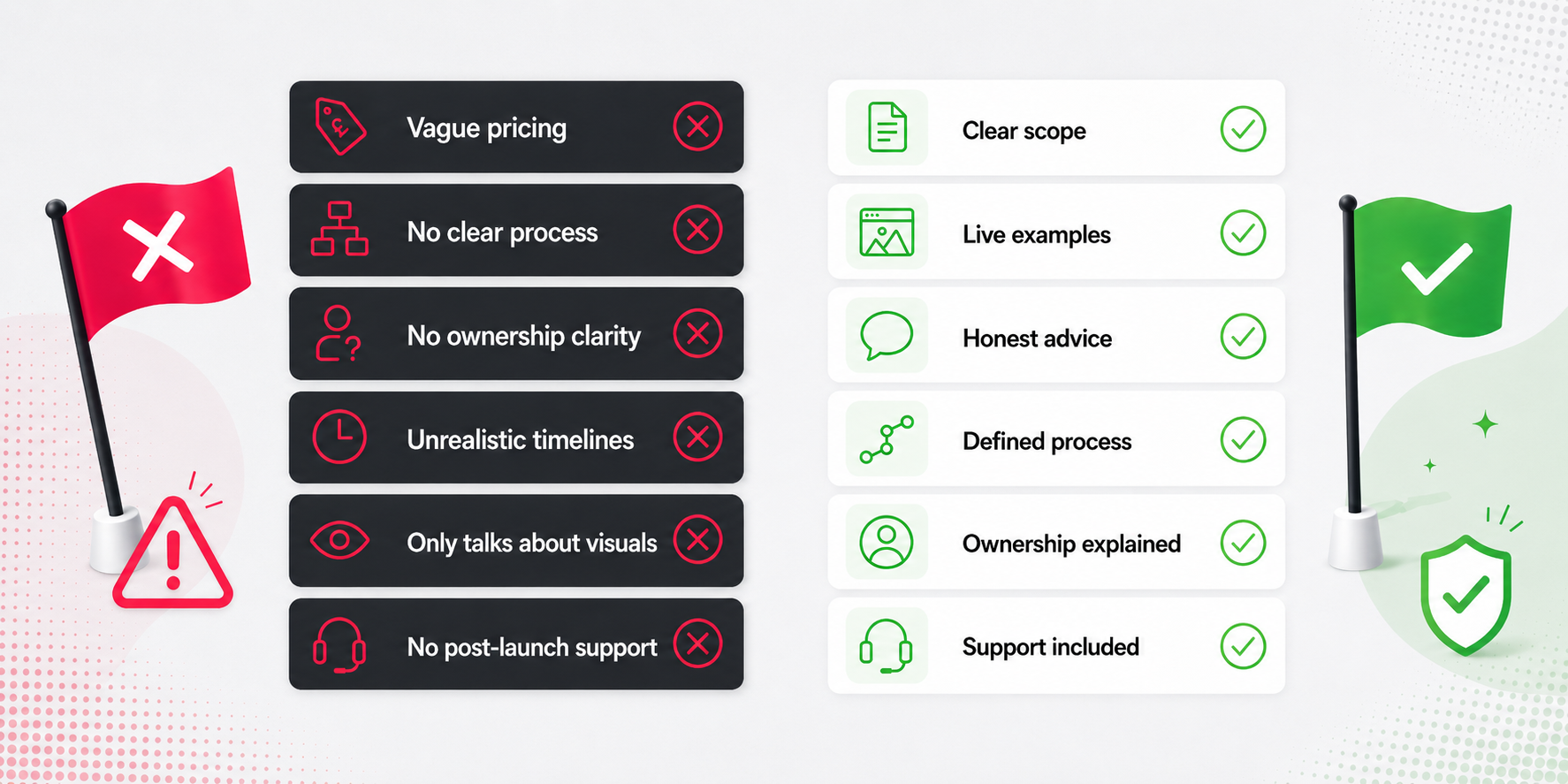
Clear scope, honest advice and support are often stronger signals than a slick sales pitch.
Vague pricing, unclear ownership, unrealistic timelines or a weak discovery process can all point to problems later in the project. Spotting these signs early can help you avoid delays, hidden costs and a website that fails to support your business properly.
Common red flags include:
- They promise very fast delivery without understanding the scope.
- They cannot explain what is included in the quote.
- They avoid questions about ownership, hosting or future access.
- They focus only on visual design and ignore content, users, SEO and conversion.
- They use too much jargon without explaining what it means.
- They have no visible portfolio, testimonials or live websites to review.
- They push a specific platform without explaining why it suits your project.
- They do not mention post-launch support, testing or training.
There are also positive signs to look for. A strong agency will usually ask thoughtful questions, explain trade-offs honestly, show relevant work, provide a clear proposal and talk about the website as a business tool rather than just a design project.
Good agencies are also realistic. They should be clear about what your budget can achieve, what will affect the timeline and where compromises may be needed. That honesty is often more valuable than a proposal that says yes to everything.
9
Compare Proposals Properly
Once you have spoken to a few agencies, you may receive quotes that vary significantly. This can make comparison difficult, especially if each agency has included a different level of detail.
Do not compare quotes by headline price alone. A cheaper quote may exclude content planning, SEO migration, responsive testing, CMS setup, training, copywriting support, accessibility checks, integrations or post-launch support. A more expensive quote may include a deeper planning process, bespoke design, custom development and better long-term flexibility.
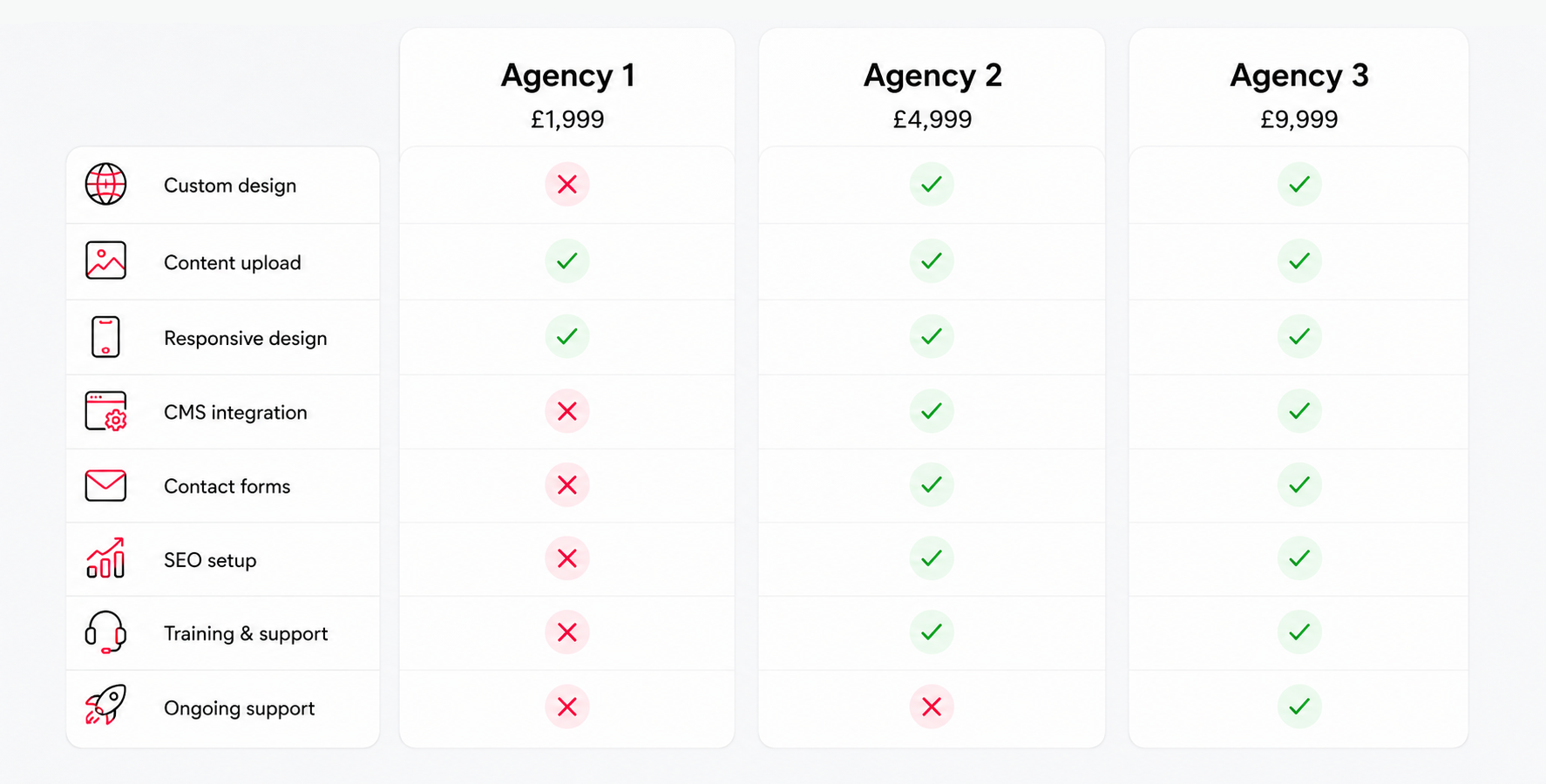
Compare proposals by what is included, not just by the headline price.
When reviewing a proposal, look carefully at:
- The project scope and deliverables
- The number of page templates or unique layouts included
- The design and development process
- The CMS setup and editing experience
- SEO, speed, accessibility and responsive testing
- Content responsibilities and migration
- Third-party integrations
- Timelines, milestones and approval stages
- Payment terms and change request process
- Support after launch
A clear proposal should reduce uncertainty. If you cannot tell what you are buying, what is included or what happens after launch, ask for clarification before making a decision.
10
Understand Website Ownership and Support
Website ownership is one of the most important details to clarify before starting a project. You should know who owns the website files, design assets, content, domain, hosting account and any custom code created for the project.
These details matter because we regularly see what happens when they are missed. In the redesigns we take on from other agencies, the most common problems are undocumented page builders nobody can unpick, abandoned plugins that no longer update, no training left for the client’s team, and owners who find they never had proper access to their own domain or hosting. Sorting that out is usually the first job of a redesign, before any new design work can begin.
You should also understand how the website will be managed after launch. Will you receive training? Can your team edit key pages? Who handles updates, backups, security and plugin maintenance? What happens if something breaks? Is there a warranty period for bugs after launch?
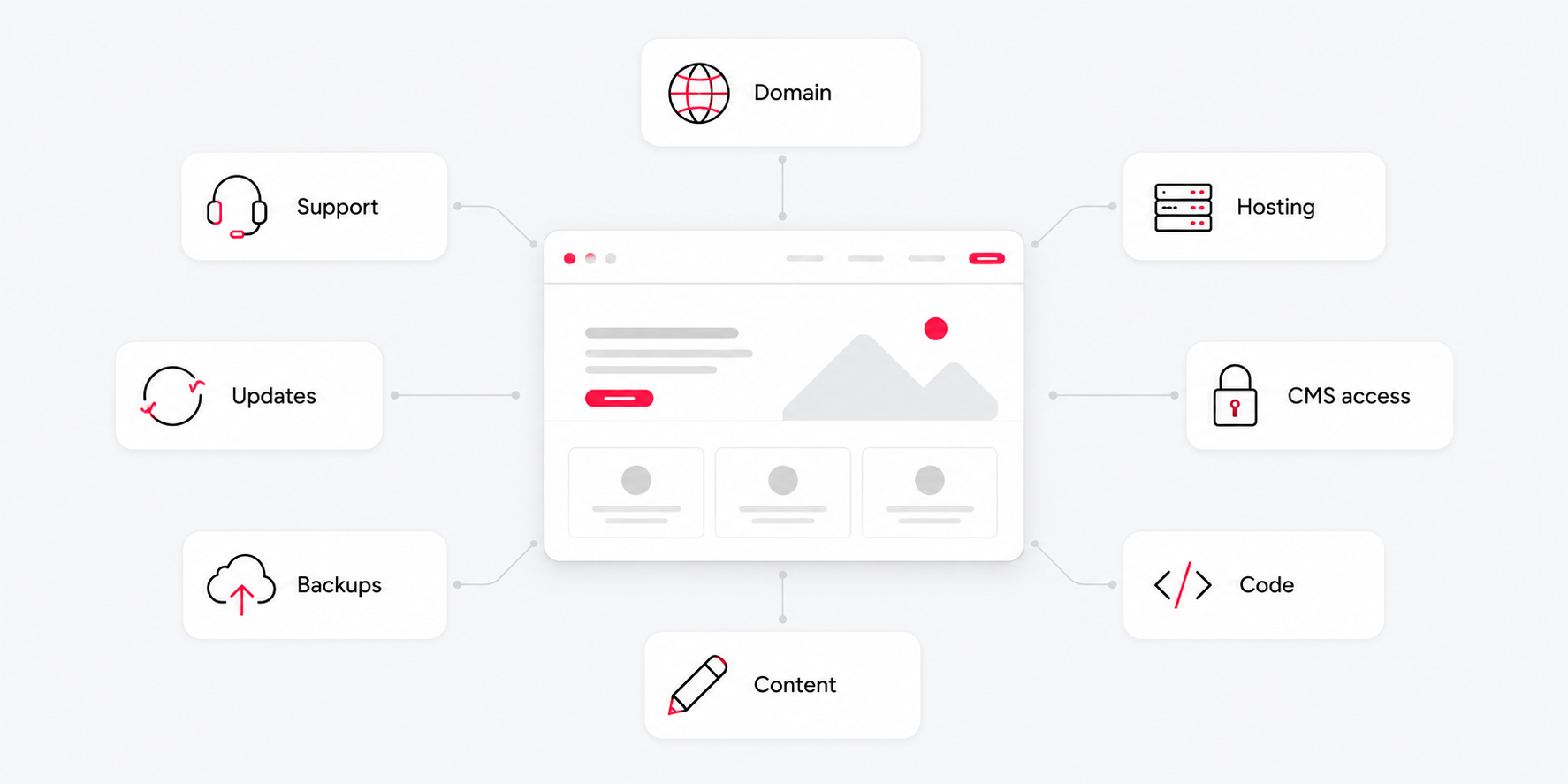
Ownership, access and support should be clear before a website project begins.
Post-launch support is especially important for WordPress, WooCommerce and websites with custom functionality. Even a well-built website needs ongoing care, updates and occasional improvements. A good agency should explain the difference between launch support, maintenance, new feature work and long-term optimisation.
This is also where the choice of CMS matters. A website should not leave you dependent on the agency for every small content change unless that is the arrangement you specifically want. The best setup gives you sensible control while still protecting the design and technical quality of the site.
Making Your Decision
After the initial consultation, take time to evaluate the agency’s proposal and determine whether the agency’s experience, approach to web design vs web development, communication style and services are the right fit for your project.
Once you decide you’d like to move forward, carefully check the agency’s terms and conditions to ensure that there are no surprises. Pay particular attention to the expected timeline, payment structure, approval stages, ownership terms and overall cost. You’ll want to fully understand what is included in the cost, such as how many design revisions you get, what functionality is covered and what support is provided after launch.
The right web design agency should give you confidence before the project begins. You should understand their process, feel comfortable with their communication and trust that they can turn your goals into a website that works for your business.
At Webpop Design, we work with businesses that need properly planned, bespoke websites rather than generic template builds. Our experience includes custom WordPress design, WooCommerce development, bespoke functionality, accessibility improvements, performance-focused front-end work and ongoing support after launch. If you are comparing agencies and want a clearer view of what your project may involve, you can view examples of our recent website projects in our web design portfolio or get in touch to discuss your website brief.
Frequently Asked Questions
What should I look for before choosing an agency?
Look for a clear process, relevant experience, strong live websites, transparent pricing and good communication. The best agencies will also ask about your goals, audience, content, SEO, functionality and what the website needs to achieve commercially.
How do I compare different agencies?
Compare the full proposal, not just the headline price. Look at the scope, number of templates, design process, CMS setup, SEO considerations, testing, support, ownership terms and how clearly each agency explains what is included.
What questions should I ask before signing?
Ask what is included, who will work on the project, how revisions are handled, what CMS will be used, whether the build is bespoke or template-based, what happens if the scope changes and what support is included after launch.
How much should I expect to pay in the UK?
The cost depends on the size of the website, level of design detail, functionality, CMS, content, integrations and support. A small brochure site may cost far less than a bespoke WordPress, WooCommerce or custom web development project.
Should I choose the cheapest quote?
Not automatically. A cheap quote may exclude planning, content structure, SEO migration, responsive testing, training, support or custom development. It is better to compare value, clarity and long-term flexibility rather than choosing on price alone.
How important is their portfolio?
A portfolio is useful, but live websites matter more than static screenshots. Check how the sites perform on mobile, whether the navigation is clear, how well the content is structured and whether the calls to action are easy to find.
What are the red flags when choosing an agency?
Be cautious if the agency gives vague pricing, avoids ownership questions, promises unrealistic timelines, cannot explain its process, has no visible proof or focuses only on design without considering users, content, SEO and conversion.
Do I need a bespoke website or a template-based build?
That depends on your goals, budget and how much control you need. A template-based website can work for simpler projects, while a bespoke website is usually better for businesses that need custom layouts, stronger brand control, flexible content editing or more advanced functionality.